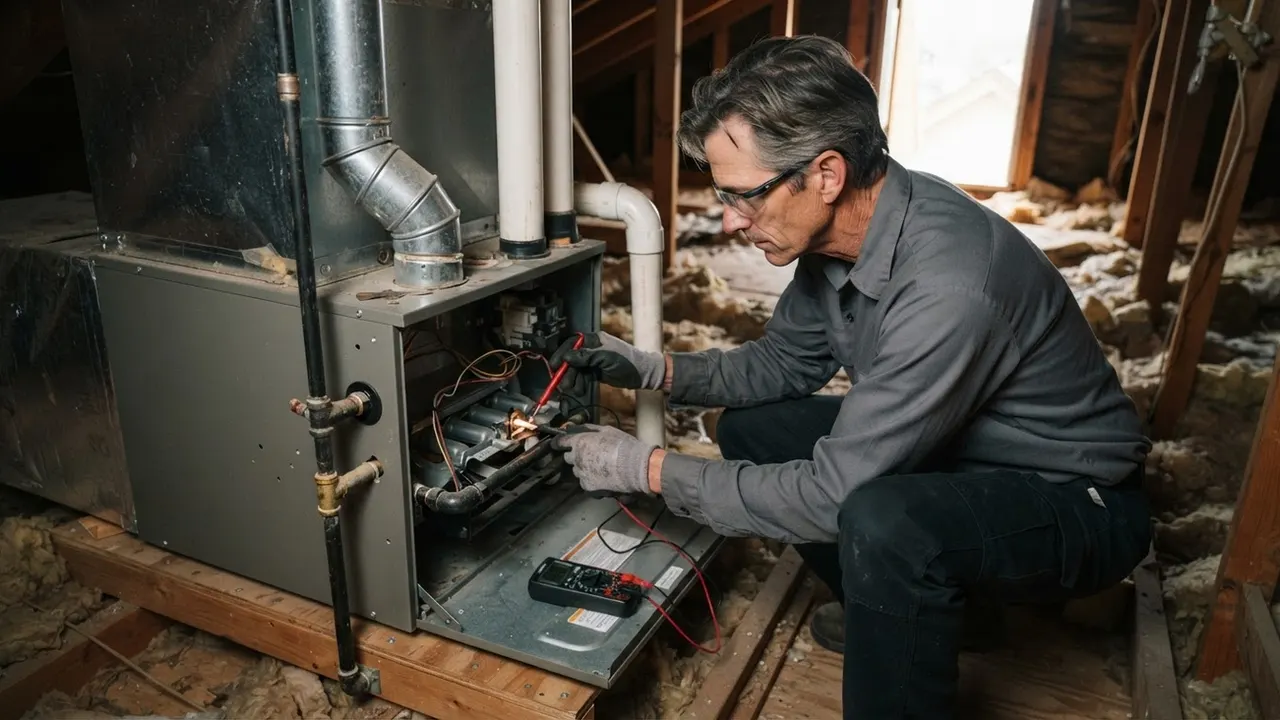
Full Ignition Sequence Test
We test the thermostat call, inducer motor, pressure switch, igniter, flame sensor, gas valve, and blower in order. That sequence tells us exactly where the heat stops, so we replace the failed part instead of guessing.
Every no-heat visit covers the full diagnostic and the repair itself. Parts are quoted separately at flat rates, and the diagnostic fee is credited toward the work. Here is what you get on the truck when we show up.
We test the thermostat call, inducer motor, pressure switch, igniter, flame sensor, gas valve, and blower in order. That sequence tells us exactly where the heat stops, so we replace the failed part instead of guessing.
On every gas furnace, we measure carbon monoxide, oxygen, and temperature rise at the flue. A cracked heat exchanger or wrong gas pressure shows up here. Safety first, then heat.
Multimeter on capacitors, control board, and limit switches. Static pressure and filter check on the return side. Restricted airflow causes a big share of no-heat and short-cycling calls, and it is usually a cheap fix.
You get the price in writing before we start. Parts and labor bundled into one number. If we find a second issue, we stop and re-quote. No hourly meter, no surprise line items.
We run two full heat cycles and confirm supply-air temperature rise is in the manufacturer range. If it is off, we adjust gas pressure or blower speed before we pack up. You feel the difference before we leave.
Furnace Not Heating Repair in Ohio is the diagnostic and repair work that restores heat when a gas or electric furnace stops producing warm air, short cycles, or blows cold. A tech pulls the fault codes, then tests the ignition sequence end to end: thermostat call, inducer motor, pressure switch, igniter, gas valve, flame sensor, blower, and limit switches. We use a multimeter and combustion analyzer to confirm the fix, not guess at it. Most no-heat calls trace back to a dirty flame sensor, failed igniter, bad capacitor, stuck gas valve, or a cracked heat exchanger that trips the safety.
Ohio winters hit hard from November through March, and a furnace that quits at 6 a.m. on a 12-degree morning is not a wait-until-Monday problem. Older housing stock in towns like Grafton and Wheelersburg often runs 20-year-old Carrier, Trane, and Lennox units that need real parts, not patch jobs. If you are searching for furnace not heating repair in Ohio near me at 2 a.m., that is exactly the call we built this service around. We keep common parts on every truck so the first visit is usually the last one.
Five steps, no mystery. Here is exactly how a Furnace Not Heating Repair in Ohio visit runs from the moment you call to the moment the house warms back up.
Schedule
Call or book online — a real human picks up and confirms a 2-hour arrival window.
Diagnose
Licensed tech inspects on-site, then walks you through the cause and your options.
Fix
The job is completed to code and done right the first time — no shortcuts, no surprises.
Guarantee
Every job backed by a written workmanship warranty — and we stand behind it.
Manifold gauge set
Measures gas pressure at the valve and manifold to confirm the furnace is running at manufacturer spec, not just lighting.
Combustion analyzer
Reads carbon monoxide, oxygen, and flue temperature on every gas furnace. The only way to confirm a heat exchanger is safe.
Multimeter
Tests capacitors, control boards, igniters, flame sensors, and limit switches. Pinpoints electrical faults in minutes instead of swapping parts.
Inspection camera
Slides into the heat exchanger and ductwork to look for cracks, blockages, and debris you cannot see from the outside.
Vacuum pump and recovery machine
Used on heat pump and AC-side work tied to furnace repairs, and for pulling a proper vacuum on any refrigerant circuit.
Duct cleaning equipment
Clears return and supply runs when restricted airflow is causing short cycling or uneven heating across the house.
Ignition sequence testing
We walk the full sequence in order: thermostat call, inducer, pressure switch, igniter, flame sensor, gas valve, blower. The first step that fails is the fault. This method stops parts-swapping and gets to the real cause in under 40 minutes.
Combustion analysis on every gas repair
Every gas furnace repair ends with a combustion analyzer reading at the flue. Carbon monoxide, oxygen, and stack temperature tell us whether the heat exchanger and gas pressure are safe. No exceptions, no shortcuts.
Static pressure and temperature rise check
We measure static pressure across the furnace and temperature rise between return and supply. Both numbers should land in the manufacturer range. If they do not, we adjust blower speed, gas pressure, or duct airflow before calling the job done.
Code-correct repair and permitting
Repairs follow Ohio mechanical code, and we pull permits when the scope crosses into replacement or venting changes. That protects you at resale and keeps the work insurable.
01
What we do: We dispatch overnight, 24/7. The tech arrives with igniters, flame sensors, and control boards on the truck, diagnoses the fault, and repairs it on the spot whenever the part is in stock, which it usually is.
→ Heat back on the same night. No hotel, no space heaters, no frozen pipes in the exterior wall.
02
What we do: We diagnose the fault, quote the repair, and give you the honest math on replacement with a new Carrier or Trane system sized to the house. You see both numbers side by side before deciding.
→ A clear decision with real numbers, not a sales pitch. Either a repair that holds or a new furnace installed in a day.
03
What we do: We check static pressure, duct condition, and blower speed. Uneven heating usually traces to undersized returns, leaky duct joints, or a blower running below spec. We seal ducts with duct sealant and set airflow correctly.
→ Room-to-room temperature gap drops to 2 to 3 degrees, and the furnace stops running nonstop.
04
What we do: We treat it as a priority call. Combustion analyzer on the flue, heat exchanger inspection with an inspection camera, and a full venting check. If the exchanger is cracked, we red-tag the unit and quote replacement.
→ A safe answer either way. If the furnace passes, you have documentation. If it fails, you are not running a dangerous unit.
Ohio winters are the whole reason this service exists. Lake-effect cold off Erie hits Chardon and Geneva hard, while southern Ohio towns like Wheelersburg and Belpre see freeze-thaw swings that stress igniters and pressure switches. Housing stock splits roughly three ways: pre-1950 homes with original ductwork, post-war ranches with undersized returns, and newer builds with high-efficiency condensing furnaces that dump condensate and clog traps. Each fails differently. A 1940s Cleveland-area bungalow usually needs duct sealing and a blower adjustment, while a 2015 build in Sunbury is more likely a condensate or pressure switch issue. We also work to Ohio mechanical code and pull permits when a repair crosses into replacement or venting changes. If you are searching for emergency furnace not heating repair Ohio on a cold Sunday, we staff for exactly that. Trucks stage across the state so a no-heat call in Cortland and a cold air furnace repair Ohio call in Milford both get same-day response.
Downtown Munroe Falls
Older homes near the river with original duct runs. Uneven heating and short cycling are common, and duct sealing usually fixes both.
Grafton Township
Rural properties on propane and well water. We check gas pressure carefully because propane furnaces run different manifold settings than natural gas.
Wheelersburg riverfront
Humidity off the Ohio River drives condensate and corrosion issues on high-efficiency furnaces. We clean traps and check the drain pan on every visit.
Cortland square area
Post-war ranches with undersized return ducts. Adding return capacity is often the fix for a furnace that runs nonstop and never reaches setpoint.
Fairlawn Heights
Larger homes with zoned systems. We test each zone damper and the control board because a stuck damper can look exactly like a furnace failure.
Lake-effect cold off Lake Erie
Temps in Chardon, Geneva, and Huron drop fast and stay low. Furnaces run near-continuous, which wears igniters and blower motors faster than in southern Ohio. We see more no-heat calls in these towns in January than any other month.
Freeze-thaw swings in southern Ohio
Belpre, Wheelersburg, and Hillsboro see repeated freeze-thaw cycles that stress pressure switches and condensate lines. A furnace that worked in December can trip a safety switch in February.
Older housing stock with original ductwork
Pre-1950 homes in Toronto, Martins Ferry, and Wellston often have undersized or leaky ducts. Restricted airflow causes short cycling and limit-switch trips, and duct sealing is usually part of the repair.
High-efficiency condensing furnaces in newer builds
Newer homes in Sunbury, South Lebanon, and Uniontown run condensing furnaces that produce condensate. Clogged traps and frozen drain lines are the top no-heat cause in these neighborhoods.
Most no-heat calls fall into a handful of failure patterns. Here are the ones we see most, what they cost you if ignored, and how we fix them.
Problem
The burner is not lighting, so the blower pushes unheated air through the house. Every hour it runs, your gas bill climbs and the house gets colder.
Our Fix
We test the igniter, flame sensor, and gas valve with a multimeter and manifold gauge set. Most of these trace to a dirty flame sensor or a failed hot-surface igniter. We clean or replace, verify flame signal, and confirm heat at the register.
Problem
Short cycling wears out the blower motor, igniter, and control board faster, and it never lets the house reach setpoint. Left alone, it usually ends in a mid-winter breakdown.
Our Fix
Common causes are a clogged filter, a failing high-limit switch, or an oversized furnace. We check static pressure, filter condition, and temperature rise, then fix the airflow or replace the limit switch. Most short-cycling calls resolve in one visit.
Problem
No inducer, no ignition, no blower. The house drops 2 to 3 degrees per hour in a hard Ohio cold snap, and pipes in exterior walls become a real risk.
Our Fix
We check power, thermostat signal, door switch, control board, and pressure switch. A failed control board or pressure switch is the usual culprit. We stock boards for Carrier, Trane, Lennox, Goodman, Rheem, York, and Bryant, so most fixes happen same-day.
Problem
On high-efficiency units, a clogged condensate line or failed drain pan can leak onto the floor, damage the furnace cabinet, and trip the safety switch.
Our Fix
We clear the condensate trap and line, check the drain pan and inducer housing, and test the safety switch. If the trap is cracked, we replace it. Water on the floor near a furnace is always worth a same-day look.
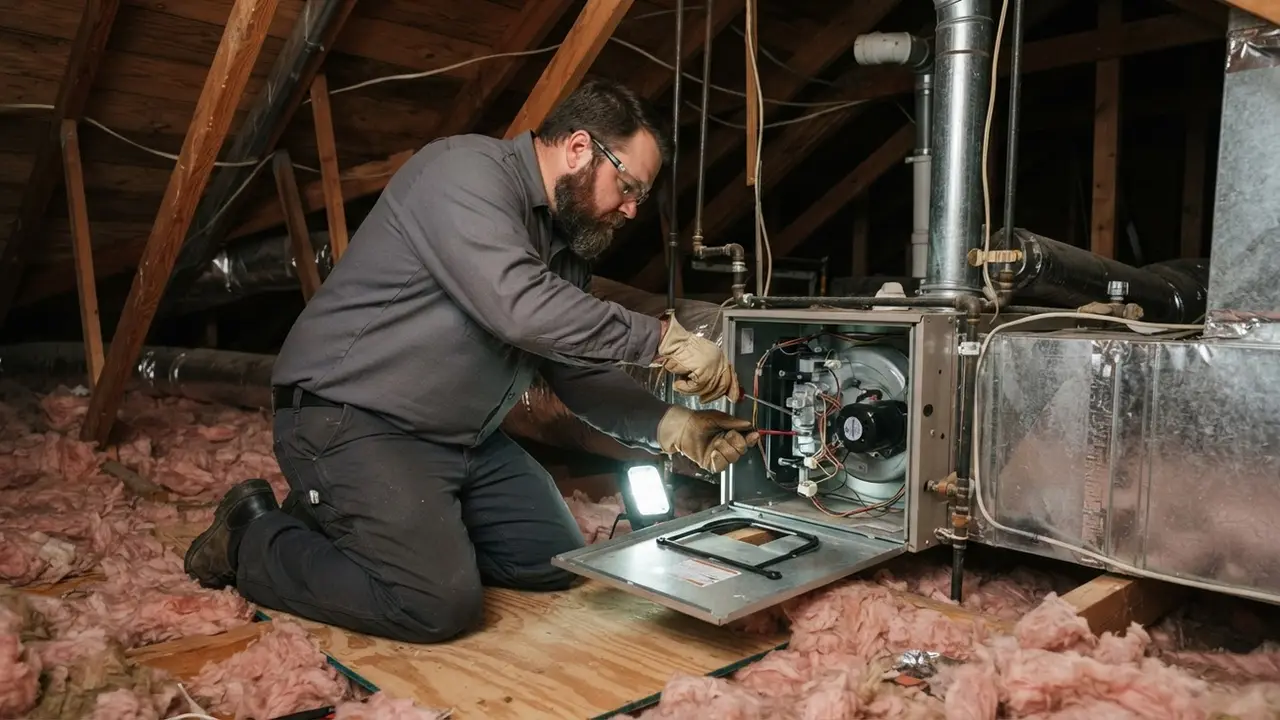
No-heat calls do not wait for business hours. We staff for the cold snap, stock the parts, and price the job before we start turning wrenches. Here is what that gets you.
Same-Day Heat Restored
We run 24/7 dispatch across Ohio, and most no-heat calls get a tech at the door the same day. Standard repairs take 1 to 3 hours once we are on site, so a furnace blowing cold air repair in Ohio rarely stretches past one visit.
Parts On The Truck
Igniters, flame sensors, capacitors, gas valves, circuit boards, and blower motors ride on every truck. That means fewer return trips and fewer nights with space heaters. We carry parts for Carrier, Trane, Lennox, Goodman, Rheem, York, Bryant, and American Standard.
Flat Pricing Before Work
You get the diagnosis and the price in the same conversation. No hourly meter running while a tech scratches his head. Typical 2026 no-heat repairs in Ohio land between $180 and $650, and you know the number before we open the toolbox.
Licensed, Insured, Code-Correct
Every tech holds a state HVAC license and works to Ohio mechanical code. We pull permits when a repair crosses into replacement territory, and we test the finished job with a combustion analyzer so the unit runs safe, not just warm.
Google ★★★★★4.9
Called at 6 a.m. with no heat and a newborn in the house. Tech was here by 9 with the igniter already on the truck. Had heat by 10:30. Price matched the phone quote exactly. These guys are the real deal.
Yelp ★★★★★4.8
Furnace was blowing cold air and I figured it was dead. Tech found a bad flame sensor, cleaned the burners, and tested with a combustion analyzer. $240 all in. He also showed me the right filter size. Honest work, no upsell.
BBB ★★★★★4.9
Third shop I called and the only one that would come out on a Sunday. Control board was shot, they had one on the truck, and the job was done in under two hours. House was warm before bed. Worth every dollar.
Emergency Furnace Repair has been fixing no-heat calls in Ohio since 2002, which puts us at 24 years on the tools. Our techs hold NATE certification and EPA Section 608 certification, and every truck carries a combustion analyzer because carbon monoxide is not something you eyeball. We have worked on every major brand, from 1980s York standing pilots to modern Daikin and Mitsubishi Electric inverter systems. That range matters when your furnace is a model most shops have never opened. We also train on Ohio mechanical code and permit requirements, so a repair never becomes a problem at resale.
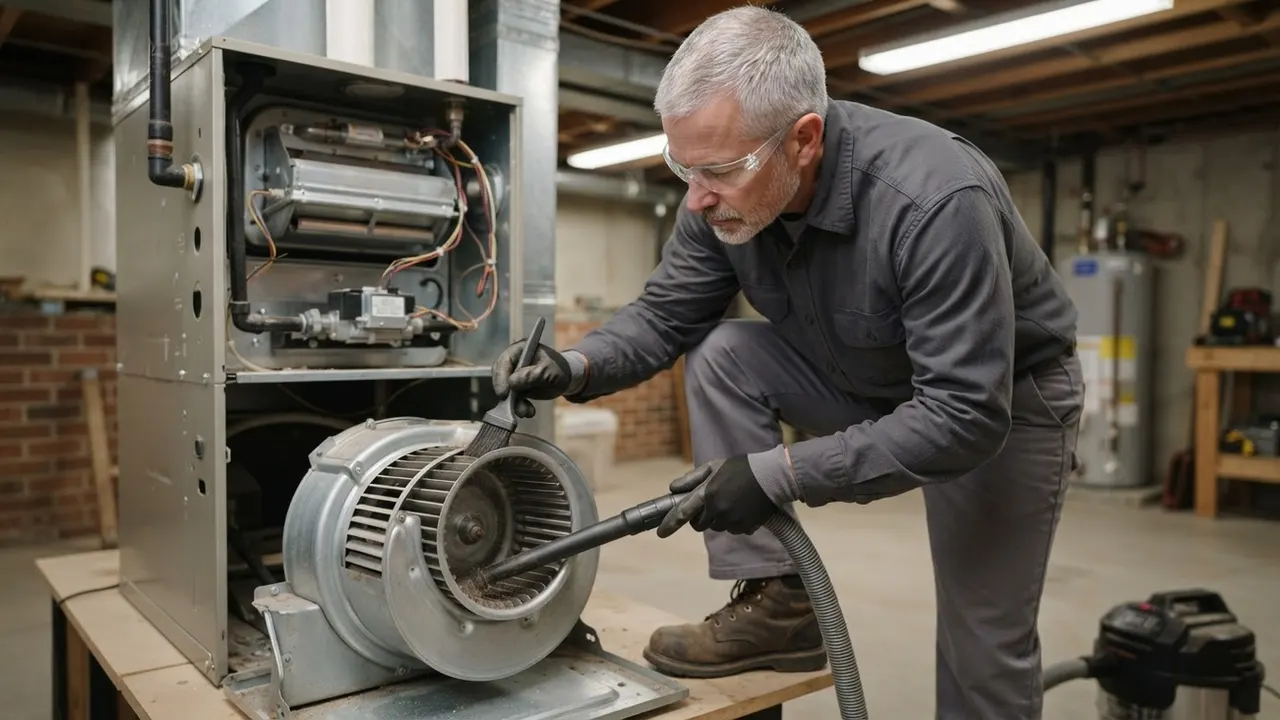
We run no-heat calls across Ohio, from small towns to inner-ring suburbs. Trucks stage regionally so a furnace blowing cold air repair Ohio call in one county does not wait behind a job two hours away. Here is a sample of the communities we cover every heating season.
Older homes near the Cuyahoga with original duct runs. We handle no-heat calls here with same-day dispatch, and duct sealing is often part of the fix for uneven heating.
Rural properties on propane and well water. Our techs set manifold pressure to propane spec and check the pressure switch on every no-heat visit.
River humidity drives condensate and corrosion issues on high-efficiency furnaces. We clean traps, check drain pans, and clear frozen lines on winter calls.
Post-war ranches with undersized returns. Short cycling and limit-switch trips are common here, and we usually fix both with airflow correction.
Larger homes with zoned systems. We test each zone damper and the control board because a stuck damper can mimic a furnace failure.
Real experiences from customers who chose our Furnace Not Heating Repair services.
“Furnace quit at 5 a.m. on a 14-degree morning. Called at 6, tech was here by 9:30 with the igniter already on the truck. Had heat by 11. Price was exactly what they quoted on the phone. No runaround, no upsell on a new furnace.”
Dave R.
Homeowner, Munroe Falls
“Our furnace was blowing cold air and we figured it was dead. Tech found a failed flame sensor, cleaned the burners, and tested with a combustion analyzer. $240 total. He also showed me the filter size so I stop buying the wrong ones. Honest work.”
Karen M.
Homeowner, Fairlawn
“Called three shops, only these guys would come out on a Sunday. Furnace was short cycling and the control board was shot. They had the board on the truck and finished in under two hours. House was warm before bedtime. Worth every dollar.”
Tom B.
Homeowner, Wheelersburg
Real answers to the questions we hear most often from local homeowners and property managers.
When your no-heat call lands at midnight and the house is dropping fast, this is the priority dispatch. Same techs, same parts, 24/7 response across Ohio. Most emergency calls get a truck the same night.
View Emergency Furnace RepairIf the old unit is past saving, we install new Carrier, Trane, Lennox, Goodman, Rheem, or Daikin systems sized to your home. Load calculation, permits, and combustion testing included. Most installs finish in one day.
View Furnace InstallationReplacement makes sense when repair costs top $1,200 on an 18-year-old furnace. We haul the old unit, set the new one, and verify temperature rise and gas pressure before we leave. Financing available on approved credit.
View Furnace ReplacementAnnual maintenance catches the flame sensor and igniter wear that causes most winter no-heat calls. We clean the burners, test the ignition sequence, and check the heat exchanger. One visit a year keeps the furnace off the emergency list.
View Furnace MaintenanceA tune-up is the lighter version: filter, burners, blower, and a combustion analyzer reading. Best done in early fall before the first cold snap. Takes about an hour and typically drops your gas bill a few percent.
View Furnace Tune-UpA full inspection covers heat exchanger, venting, gas pressure, electrical, and airflow. Useful before buying a home or after a carbon monoxide alarm. You get a written report with photos and any code issues flagged.
View Furnace InspectionCall us any hour, any day. Our dispatchers answer live, give you a realistic arrival window, and route the closest truck to your address. If you prefer, send an email and we will reply the same business day with scheduling options.
Phone
+16149260837Address
875 Freeway Dr N, Columbus, OH 43229
Hours
Mon–Fri: 7AM – 7PM
Sat: 8AM – 4PM
Sun: Emergency Only
24/7 Emergency Available